


When seconds decide outcomes
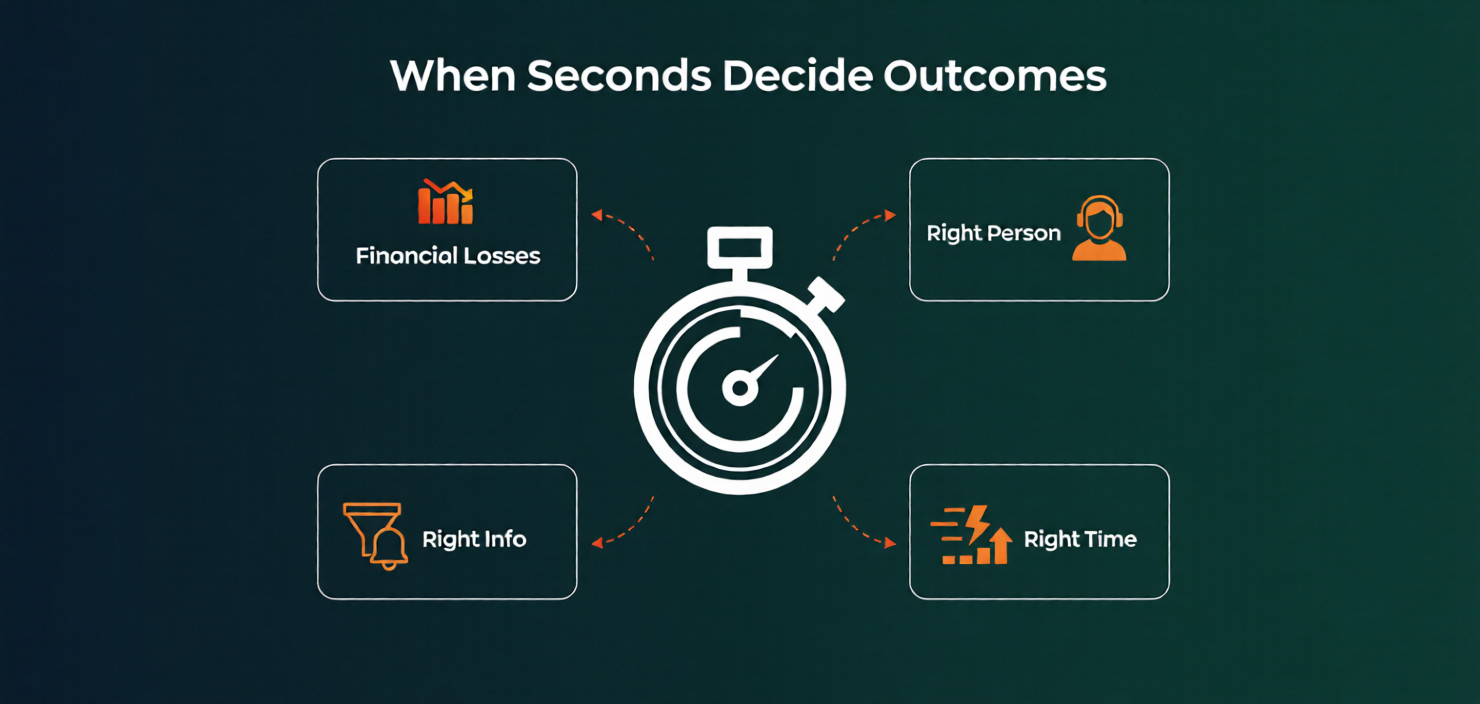
In senior living, critical events rarely announce themselves. A resident with Alzheimer’s can drift toward an exit without warning. A fall can happen behind a closed door. A request for help can arrive late because a resident is confused, a button is out of reach, or the staff member on duty is already responding elsewhere. These moments are clinical, operational, and emotional at the same time. They shape outcomes for residents, trust for families, and pressure for staff.
That pressure is not abstract. It shows up in the simplest question every team faces: what is happening right now, and where? When awareness starts late, every step after that becomes harder. Response slows, risk rises, and confidence drops. Modern senior living safety has one constant requirement. The right person needs the right information fast, without digging through noise.
The risk landscape has changed

Resident profiles have shifted. Higher acuity is more common. Cognitive decline is part of daily operations in many communities. Families also expect clarity and accountability. Operators face tighter staffing and rising expectations at the same time. Under these conditions, safety cannot depend on perfect workflows. It cannot rely on residents pressing buttons at the right moment. It cannot require staff to be in the right corridor at the right time. And it cannot depend on a single, isolated system to carry the load.
Legacy safety models often fail because they were designed for less complex environments. They react only after incidents occur, generate context-free alerts, and increase workload rather than reduce it. This creates a gap between community needs and the capabilities of traditional tools.
The core problem: reactive safety in a real-time environment

Surveys indicate that 87% of operators report an increase in acuity levels among their resident populations. This shift means that cognitive decline, multiple chronic conditions, and extreme frailty are now the operational baseline rather than the exception.
Unfortunately, most communities still operate with reactive safety patterns. For example, a door alarm only triggers when a resident reaches a threshold. A nurse call system only activates if the resident can press the button. A fall is discovered only when someone enters the room. In each case, the clock starts late. This delay often means the difference between a controlled situation and an escalating event.
Reactive systems also tend to produce alert noise. Staff receive signals that lack priority and context. This forces triage by guesswork. Over time, fatigue sets in. Response becomes inconsistent. True emergencies compete with low-importance alerts. The issue is not the number of tools available. It is that the tools often do not form one coherent operating model.
Communities do not need more alerts. They need continuous awareness and clear workflows. They need safety that supports independence, not confinement.
The new model: continuous safety without confinement

Rythmos is positioned around a single idea: Safety Without Walls. The entire platform is designed to maintain continuous resident protection without forcing restrictive living models. It aims to replace late awareness with real-time visibility and operational clarity. The goal is straightforward: faster response, less noise, and coverage that holds up under staffing pressure.
This matters because safety in senior living is not just one problem. Rather, it is a set of overlapping risks. For example, wandering is not separate from access control. Falls are not separate from emergency communication. Location awareness is not separate from response coordination. Rythmos unifies these needs as parts of one system with one purpose: to support everyone involved, from residents and their families to staff and leadership.
What follows is a high-level view of the core service areas, described in outcome language. The focus stays on what changes in day-to-day operations, not on hardware details.
Wander management: prevent escalation, not only exits

Wandering and elopement risk is one of the most sensitive challenges in memory care. The danger is not only the door. It is the delay between the start of unsafe movement and staff awareness. Traditional approaches often depend on alarms that trigger too late or require constant manual monitoring. That creates stress and uncertainty, especially during shift changes or busy periods.
Rythmos positions wander management as proactive rather than reactive. The goal is earlier awareness and clearer response. This supports safer movement without turning the environment into a locked maze. For residents, this can preserve dignity and autonomy. For families, it reduces the fear that an incident will go unnoticed. For staff, it reduces the burden of constant door watching and reactive searching.
Fall detection: support fast response when residents cannot ask for help

Falls are high-impact events because they do not always allow a resident to call for assistance. Falls in long‑term care occur at roughly 3–5 per 1,000 bed‑days. The most serious cases often happen when someone is alone, disoriented, or unable to reach a device. In many communities, the response begins only after a delay, when the fall is discovered indirectly. Around 10-20% of these falls cause serious injury, and about 1,800 U.S. nursing home residents die annually from fall injuries.
Rythmos frames fall detection around rapid awareness and reduced uncertainty. The intended outcome is faster intervention and fewer missed events. This is also about staff confidence. When alerts are more reliable and better prioritized, teams trust the system. Trust reduces fatigue. It also makes responses more consistent, which is the foundation of safer care.
Nurse call and emergency communication: modern response without fixed points

Traditional nurse call systems often assume a fixed environment and a resident who can reliably use wall-mounted buttons. A long–term care–focused analysis cited alert fatigue as a major issue and reported that operators anecdotally see ~80% of nurse-call alerts as false or inappropriate, leading to slower responses and increased hospitalizations and negligence claims.
In reality, the need for help can arise anywhere, and the resident may not be able to reach a control point. When calls lack location context, staff waste time searching for the source and assessing urgency.
Rythmos positions emergency communication as mobile, immediate, and easier to route. The purpose is not to add more ways to call for help. The purpose is to reduce the gap between request, awareness, and response. When response becomes faster and more predictable, residents feel safer, and staff feel more in control.
Real-time location and access control: awareness without confinement

Dementia‑related wandering is common; a classic study examined 62 elopements from long‑term care facilities by residents with dementia, documenting repeated patterns of inadequate precautions despite known intent to elope and prior exit‑seeking behavior. These incidents often involved environmental or process failures (unsecured exits, inadequate observation, poor handoff communication)
Location awareness solves a basic operational problem: searching. When staff must physically hunt for a resident or guess where an incident occurred, response slows, and stress rises. At the same time, access control in senior living is not a generic security need. It is a safety need, especially around exits and sensitive areas.
Wandering illustrates the challenge clearly. Studies show that up to 60% of individuals with dementia will wander at least once, and elopement risk is especially concentrated during transition periods such as the first 48 hours after admission.
Rythmos frames location and access control as part of a unified safety objective:
- Earlier signal, not later alarm – Awareness begins with movement patterns, not just door thresholds.
- Context-aware response – Alerts incorporate location, risk profile, and time-of-day context.
- Reduced manual searching – Staff spend less time physically locating residents during incidents.
- Controlled freedom of movement – Residents retain autonomy while high-risk zones remain intelligently managed.
- Policy-driven triggers – Configurable workflows adapt to acuity level and cognitive status.
- Documentation-ready event capture – Location data supports defensibility and regulatory clarity.
From Alerts to Operational Intelligence

Rythmos materials consistently distinguish “intelligent awareness” from simple alerting. The product is positioned as an operational intelligence layer that connects signals to workflows. That matters because the hardest part of senior living safety is not collecting data. It is turning signals into timely, actionable decisions without overwhelming staff.
This platform-level framing also supports leadership needs. Operators need visibility into response patterns. They need to understand where delays happen and how to improve them. Owners and portfolio leaders need scalable consistency. They need systems that can expand across communities without becoming a maintenance burden.
A platform approach also supports integration. The stated philosophy is clear: data should be usable and portable, while the operational intelligence that prioritizes and routes work remains the differentiator. That aligns with how large organizations evaluate long-term technology risk.
What does this change mean for each group involved

For residents, the promise is protection that does not erase autonomy. Safety should not automatically mean restriction. For families, the value is confidence. The facility can demonstrate control and responsiveness rather than asking for blind trust. For staff, the benefit is relief from constant uncertainty. Clearer signals and better routing reduce noise and stress, especially during high-load periods.
For operators, the value is operational control and risk reduction. Faster response and better documentation strengthen outcomes and defensibility. For owners and portfolio leaders, the opportunity is standardization. A scalable safety approach supports consistency across buildings, which is critical for reputation and long-term performance.
Closing: the shift from devices to operational clarity

Senior living facilities have numerous devices, but awareness of them remains fragmented. As resident acuity rises and staffing decreases, standalone tools and threshold-based alarms cannot effectively manage real-time risk.
The future of safety in senior living does not depend on adding more hardware. Rather, it is about establishing operational clarity, which includes continuous visibility, intelligent prioritization, and a coordinated response across the entire community.
Rythmos is designed to support this change. “Safety Without Walls” represents a structural shift: protection starts earlier, extends across portfolios, and enables independence while maintaining control. In modern senior living, safety is not just a feature; it is part of the infrastructure.

 Alexey
Co-Founder & CEO
Alexey
Co-Founder & CEO

 Ivan
Co-Founder & CTO
Ivan
Co-Founder & CTO
-
 alexey.grebennikov@aionys.com
-
10:00AM - 07:00 PM GMT+2
-
ivan.korytin@aionys.com
-
10:00AM - 07:00 PM GMT+2


